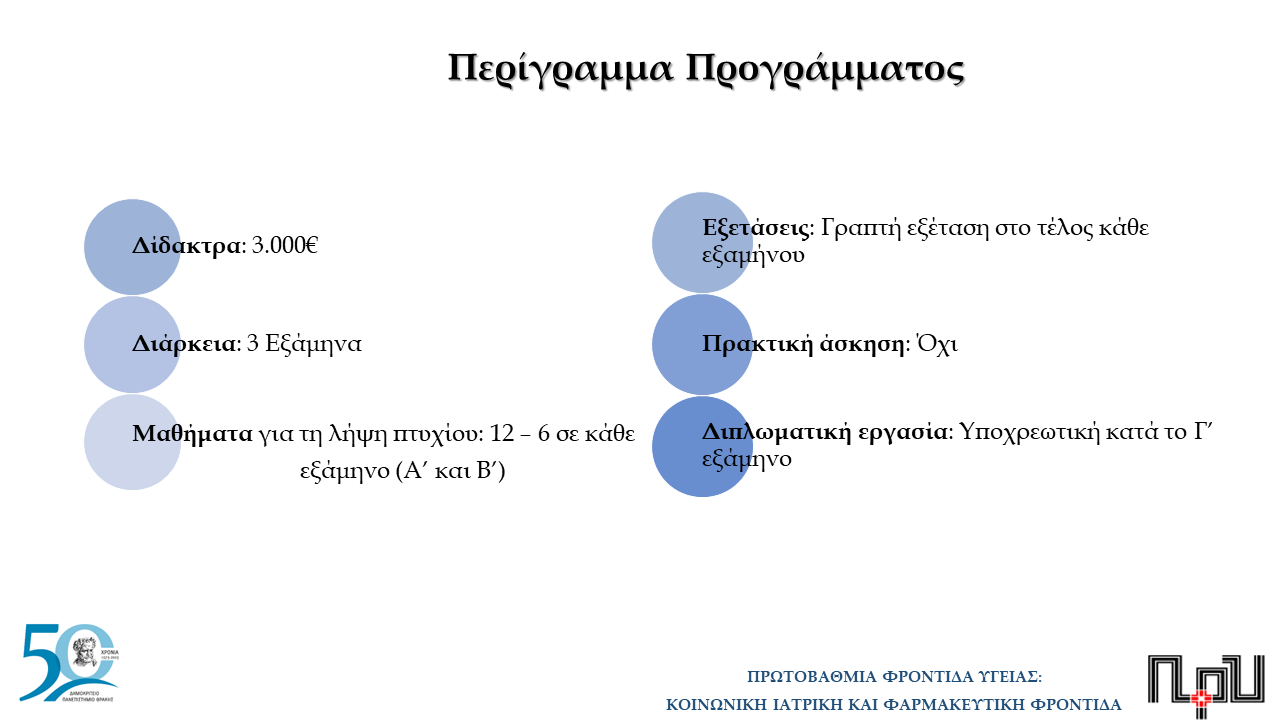




The Postgraduate Studies Program
Physiognomy of the Primary Health Care System.
Primary Health Care (PHC) is understood as the set of integrated services that aim to monitor, maintain and improve human health. The services include health promotion, disease prevention, diagnosis, treatment, comprehensive care and its continuation. The State has the responsibility for the provision of quality PHC services to the entire population, with respect for their rights and needs.
Primary care services consist of:
a) health services for the provision of which the individual does not require admission to a nursing institution,
b) the assessment of citizens' health needs, the design and implementation of measures and programs for disease prevention, the universal implementation of a national screening program for selected diseases and health promotion,
c) the regular monitoring and management of patients with chronic diseases,
d) family planning and maternal and child services,
e) referral, monitoring and, where appropriate, co-management of cases in Secondary and Tertiary Care,
f) the provision of emergency pre-hospital care,
g) the implementation of vaccination programs,
h) rehabilitation services,
i) the provision of palliative and comfort care,
j) the provision of Primary Mental Health services and the interface with mental health services,
k) Primary Dental and Orthodontic Care, with an emphasis on prevention,
l) the connection with social care services.
Primary Health Care services are structured, developed, organized and operate based on the principles of free universal health coverage of the population, equal access to health services, outreach to excluded and vulnerable social groups, ensuring the quality and safety of the services provided, continuity of health care, responsibility and accountability of health service providers, sectorization, medical, nursing or other professional ethics, proximity of services to the place of residence, stay or work, interconnection with other health services, rational referral to other units or services of the National Health System or contracted providers for diagnosis, treatment, hospitalization or further care, inter-sectoral cooperation with local, social and scientific bodies, as well as health education of the community and its active participation in meeting its health needs.
Primary Health Care (PHC) serves to provide universal and equal health coverage to all citizens. In Greece, PHC, despite continuous legislative regulations and interventions since the establishment of the National Health System (ESY) until today.
Objectives of the Postgraduate Studies (P.M.S.) "Primary Health Care: Social Medicine and Pharmaceutical Care"«
The Postgraduate Studies Program (P.M.S.) "Primary Health Care: Social Medicine and Pharmaceutical Care" is part of the strategic planning of the University of Thessaloniki, which aims to further promote knowledge, develop research and the arts, meet the educational, research, social, cultural and developmental needs of the country, and provide graduates with a high level of specialization in theoretical and applied areas of specific disciplines, special thematic units or individual branches of the subjects of the first cycle of studies of the relevant Department.
Learning outcomes of the Postgraduate Studies (P.M.S.) "Primary Health Care: Social Medicine and Pharmaceutical Care"«
The field of study of the Master of Science (MSc) is Primary Health Care (PHC) and its holistic management. The purpose of the MSc. «Primary Health Care: Social Medicine and Pharmaceutical Care» is to train competent graduates from Health Sciences and related departments, so that they can be trained in Primary Health Care issues. In particular, to give postgraduate students a comprehensive picture of PHC and policies for the prevention of diseases in the wider social space. It also aims to train and specialize young scientists from the field of Primary Care, who will be able to implement and shape Primary Health Care policies in our country, develop programs at all levels, evaluate citizens' problems, implement preventive measures and tools and deal with disease-causing factors. Finally, the MSc. aims to contribute to the training of those who perform duties in the field of Health Sciences, as well as to contribute to the further education of trainees and specialists of all specialties and in particular General Practitioners, Occupational Physicians, Dentists, Pharmacists, Nurses, Dietitians, Psychologists, Veterinarians as well as all scientists who are generally involved in the field of Primary Health Care.
After successfully completing their studies, postgraduate students will be able to:
• identify, implement and shape primary healthcare policies in our country
• develop health promotion programs at all levels, within the framework of the Directors of Primary Health Care
• assess the main health problems of citizens and implement preventive measures
• identify and evaluate factors related to major primary health care issues
• develop measures to monitor and address primary health care issues in the form of Health Policies
Exams and Course Evaluation
Course evaluation is done through a written or oral examination, assignment, presentation, report or a combination of the above.
The exact form of assessment is determined by the teacher or teachers in relation to the nature of each course.
The evaluation terms for each course are announced at the beginning of the course by the faculty member responsible/coordinator of the course.
For courses in which the assessment is done by oral and/or final written examination, the following applies:
Winter semester courses are examined in February.
Spring semester courses are examined in June.
For courses in which assignment submission is required, the following applies:
For winter semester course:
The topic of the assignment is given by the instructor by the end of January and the assignment is submitted by the student by March 31.
For spring semester courses:
The topic of the thesis is given by the instructor by June and the student submits it by September 10.
Intermediate exercises and assignments that are also part of the assessment of postgraduate students may be assigned by lecturers with a delivery time of up to 30 days from their assignment.
After the end of the examination, the exercises, written essays and any other examination documents are delivered by the instructor to the Secretariat for safekeeping.
The time and duration of the examination periods of the Master of Science are determined by the Assembly of the Master of Science Department following a recommendation from the Academic Council.
Course evaluation can also be done remotely using the digital evaluation method provided by the DUTHNET eClass distance learning platform of the Department of Medicine, University of Thessaloniki.
The grading scale for evaluating the performance of postgraduate students is set from zero (0) to ten (10):
«"Excellent" from eight and fifty (8.50) to ten (10),
«"Very good" from six and fifty (6.50) to eight and forty-nine (8.49),
«"Good" from five (5) to six and forty-nine (6.49).
Duration of study, Suspension of study and deletion
Duration of Studies
The normal duration of study in the P.M.S. P.F.Y. leading to the award of the Postgraduate Diploma (D.M.S.) is set at three (3) semesters, which also includes the time for the possible preparation and submission for assessment of the Postgraduate Diploma Thesis (M.D.E.). The time related to the diploma thesis cannot be less than three months. Study in the program is considered to end upon completion of the minimum study period (three (3) semesters) and upon completion of the writing and public presentation of the Postgraduate Diploma Thesis.
Part-time study
For postgraduate students, the possibility of part-time study is provided for in accordance with paragraph g) of paragraph 4 of article 79 of law 4957/2022 (A' 141) for working students, the duration of which cannot exceed twice the normal study period. Part-time study is also provided for non-working postgraduate students who are unable to meet the minimum requirements of the full-time study program and for special extremely serious cases. In this case, an application is submitted by the postgraduate student together with the relevant supporting documents (certificate from the employer and the relevant insurance institution, certificates proving the serious reason, illness, military service, reasons of force majeure).
The supporting documents are examined by the Coordinating Committee and the request is forwarded for approval to the Department Assembly.
Suspension of Studies
In exceptional cases, postgraduate students are granted, upon submission of a relevant reasoned application, a temporary suspension of studies, which may not exceed two (2) consecutive semesters. During the suspension, the postgraduate student loses his/her student status. The period of suspension is not counted towards the maximum duration of regular studies.
Upon returning to studies, the student continues to be subject to the study status of the time of his/her registration as a postgraduate student.
The suspension is granted by decision of the Assembly, following a recommendation from the Supervisory Board.
Deleting postgraduate students
The Department Assembly decides on the re-examination of courses upon request of the postgraduate student to an examination committee appointed in accordance with the provisions of article 8 of these Regulations.
The Department Assembly decides to expel a postgraduate student for the following reasons:
a) the insufficient progress of the postgraduate student, which is documented by unjustified non-participation in the educational process, i.e. attendance, exams in a percentage greater than 60% of the hours of attendance and participation in course exams
b) the improper fulfillment of other obligations defined by the relevant Regulation,
c) behavior that violates academic ethics according to applicable legislation and the code of ethics of the University of Thessaloniki.
d) application by the postgraduate student himself/herself