Postgraduate Course Structure
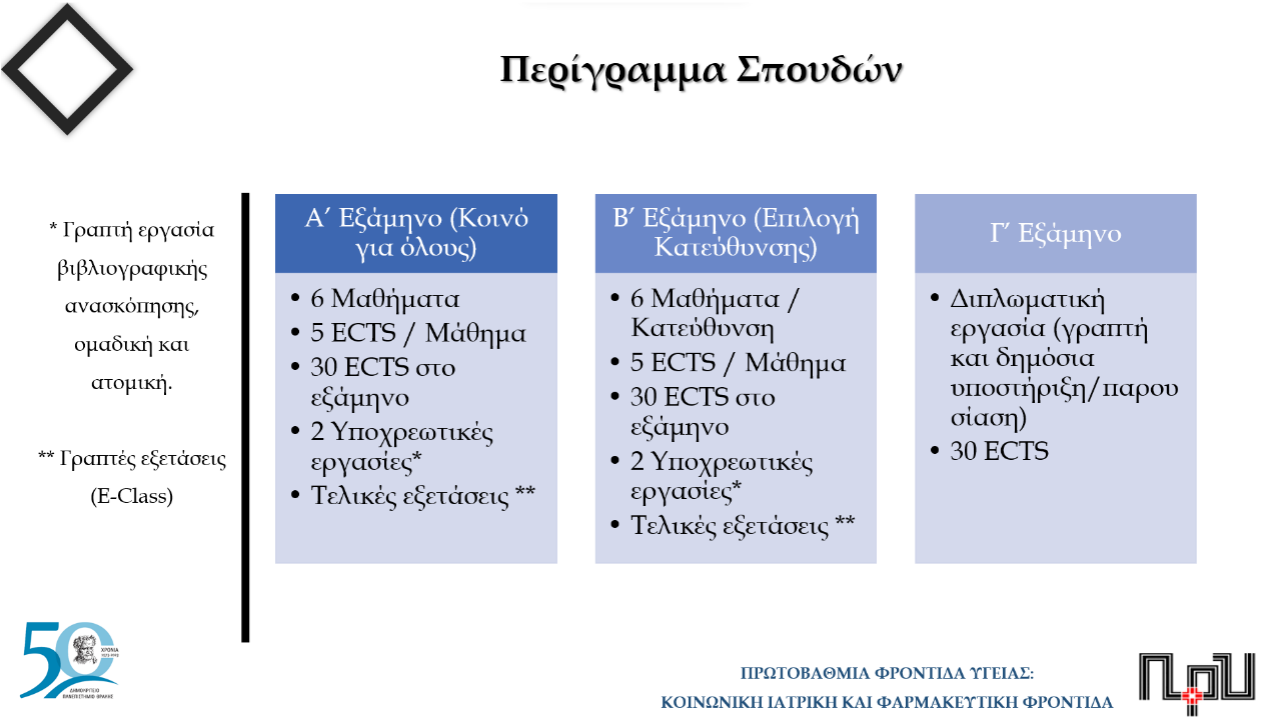
The total number of Credit Units (ECTS)* required to obtain the D.M.S. is 90.
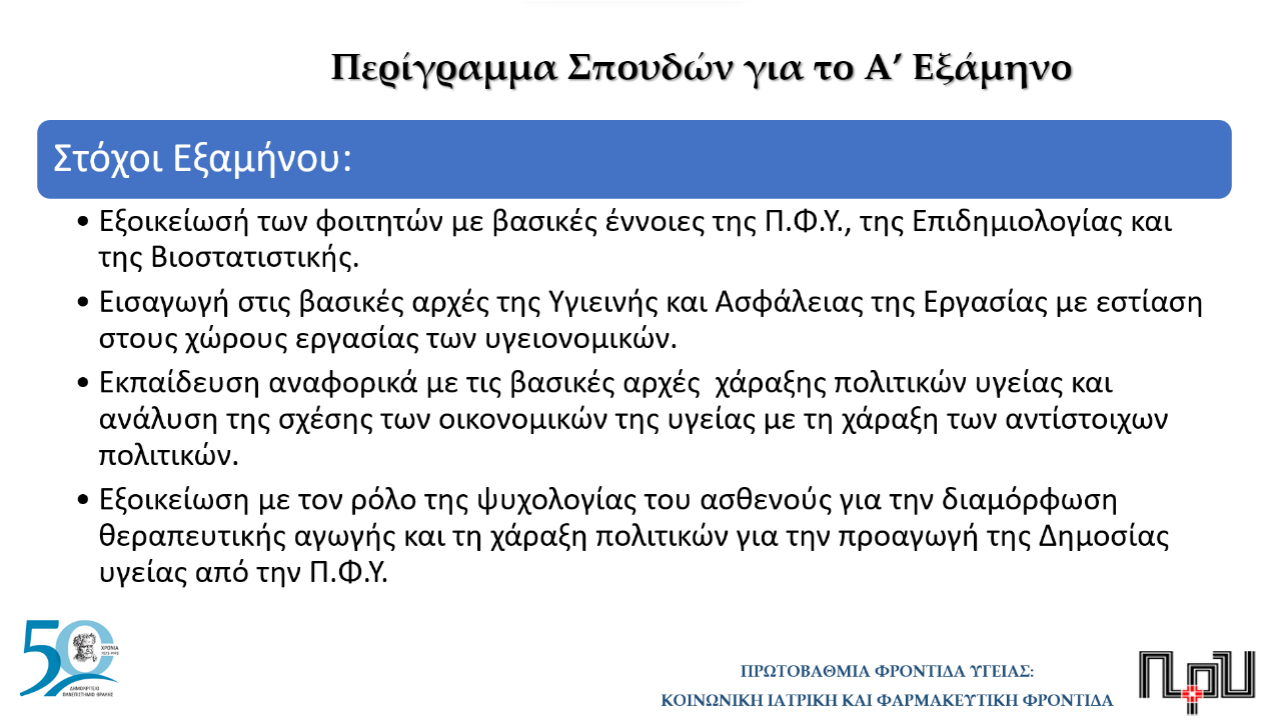
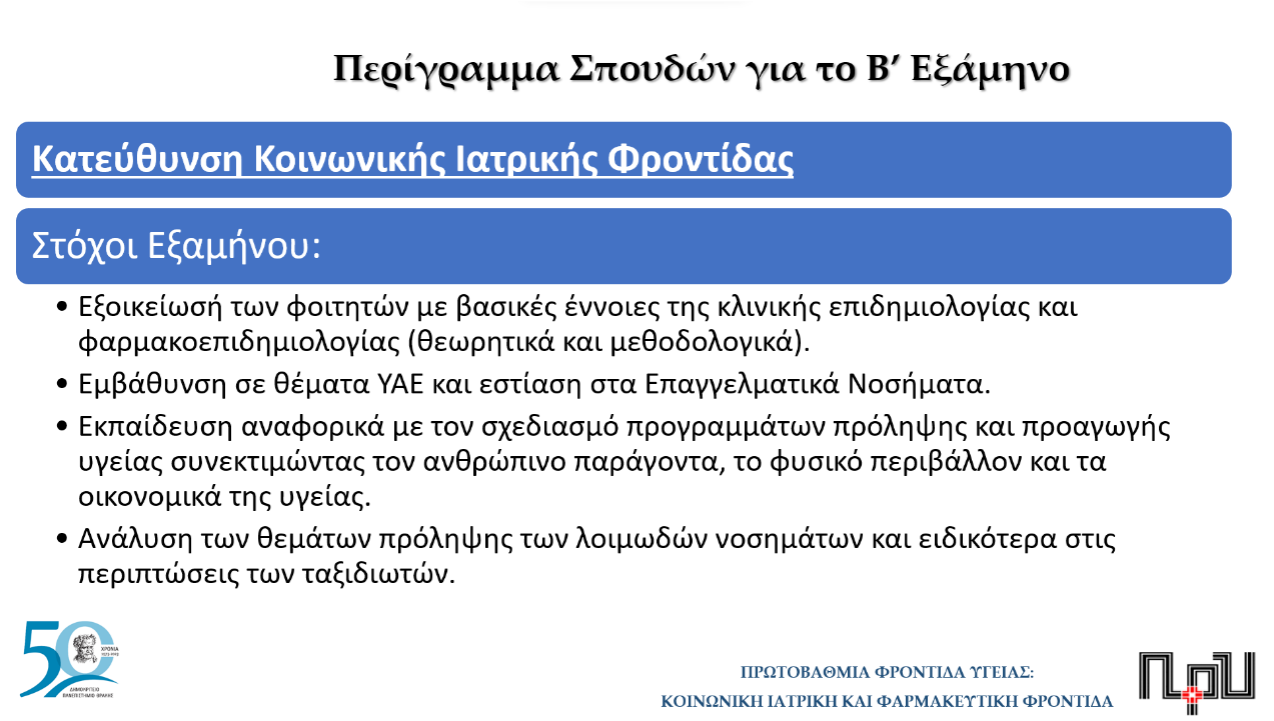
To obtain the D.M.S., mandatory attendance and successful examination in all mandatory courses are required, as they are distributed over the two semesters of study (A and B). During the second semester of study, postgraduate students are invited to choose a direction of attendance with a subject:
A Direction: Social Medical Care
B Direction: Social Pharmaceutical Care
The choice of direction is made at the end of the first semester with the written application of each postgraduate student to the Secretariat of the Postgraduate School.
The program includes mandatory coursesThe program includes mandatory courses which may be taken online up to seventy percent (70%) or as defined by the applicable provisions. The diploma thesis is prepared in the third semester.
* ECTS: European Credit Transfer System
The European Credit Transfer and Accumulation System (ECTS) is a student-centred system based on the transparency of learning outcomes and learning processes. It aims to facilitate the planning, delivery, assessment, recognition and validation of qualifications and learning units, as well as student mobility. ECTS is widely used in formal higher education and can be applied to other lifelong learning activities.
The transfer and accumulation of credits are facilitated by the use of the core ECTS documents (course catalogue, student application form, learning agreement, transcript of records), as well as the Diploma Supplement.
The University of Thessaloniki organizes its study programs based on the European Credit Transfer and Accumulation System (ECTS), so that they can be described by assigning credit points to all the independent educational components and activities that compose them and so that it is also possible to transfer and accumulate successful performances to other corresponding study programs of the same or another HEI at national and European level.
The European credit transfer and accumulation system is based on the workload that each student is required to undertake to achieve the objectives of a study program, depending on the learning outcomes, knowledge, abilities and skills that are sought to be acquired after its successful completion.
The learning outcomes are determined by the relevant lecturers. Credits are assigned to each course (lecture, workshop, seminar, etc.), internship, degree or diploma thesis and anything else that is necessary, according to the curriculum, to achieve the desired learning outcomes, depending on the subject of each planned educational process.
The workload required of each student corresponds to sixty (60) credit units per academic year and thirty (30) credit units per semester. Accordingly, the maximum number of credit units that can be attributed to each independent educational component or activity of the curriculum is determined by a decision of the Department Assembly.
Credits are awarded to students only after successful examination and corresponding proof of the degree of success of the respective objective goals or learning outcomes pursued with each independent educational component or activity of the curriculum.
3rd SEMESTER
|
Compulsory Courses
|
ECTS Credits
|
|
Completion of a master's thesis
|
30
|
|
Total Credits
|
30
|
ECTS: European Credit Transfer System
Postgraduate Diploma Thesis
The postgraduate student is required to prepare and successfully defend his/her postgraduate thesis which is assigned to the 4ο semester of studies.
The topic of the M.D.E. must be part of the subject of the P.M.S. and utilize the knowledge acquired in the P.M.S. courses and in specific applications.
Regarding the undertaking, preparation and support of the Thesis, the following are defined:
Application – Submit a topic
The postgraduate student has the right to submit a Master's Thesis upon successful completion of the courses up to the third (3rd) semester of studies.
The postgraduate student submits an application, indicating the proposed title of the thesis, the proposed supervisor and attaching a summary of the proposed thesis to the Secretariat of the M.P.S.
Postgraduate students who do not submit the application within the time limits set by the internal Regulation, postpone, at their own risk, the start of the preparation of the M.D.E. by at least one semester.
Supervision of N.D.E.
The Coordinating Committee (C.C.), upon request from the candidate, appoints the candidate's supervisor and forms the three-member examination committee for the approval of the thesis, one of whose members is the supervisor.
The following have the right to supervise theses:
a) members of the Teaching and Research Staff (T.E.P.), Special Educational Staff (S.E.P.), Laboratory Teaching Staff (E.D.I.P.) and Special Technical Laboratory Staff (E.T.E.P.) of the Department or other Departments of the same or another Higher Educational Institution (HEI) or Higher Military Educational Institution (ASEI), with additional employment beyond their legal obligations, if the P.M.S. has tuition fees,
b) Emeritus Professors or retired faculty members of the Department or other Departments of the same or another HEI,
c) collaborating professors,
d) appointed teachers,
e) visiting professors or visiting researchers,
f) researchers and specialist operational scientists of research and technological bodies of article 13A of Law 4310/2014 (Government Gazette A' 258) or other research centers and institutes at home or abroad, provided that they hold a doctoral degree.
By decision of the competent body of the P.M.S., the supervision of theses may also be assigned to members of the Department's Faculty, Academic Staff and Academic Staff, who have not undertaken teaching work at the P.M.S.
The members of the Three-Member Examination Committee must have the same or a related scientific specialty as the subject of the P.M.S.
In exceptional cases of loss, objective inability to exercise supervisory duties or serious reason, it is possible to replace the supervisor or member of the Three-Member Examination Committee following a decision of the Assembly of the relevant Department.
Writing Postgraduate Diploma Thesis
Writing a postgraduate thesis is an obligation of postgraduate students to complete their studies.
The postgraduate thesis must:
- is the result of individual study by the postgraduate student,
- This is an original research study and not a literature review.
- adheres to the rules of ethics and morality
- follows the rules on copyright and plagiarism
The typical structure of a postgraduate thesis (MDE) includes:
- Import
- Purpose
- Methodology
- Results
- Conclusions
- Bibliography
In addition, the MDE is written in a word file, with:
- Arial or Times New Roman text font
- font size 11 or 12,
- full text alignment,
- line spacing 1.15,
- adding a space after a paragraph.
Images and graphs should be captioned with consecutive numbering and referenced within the text. Especially images that are not the intellectual property of the postgraduate student should be accompanied by the relevant permission for their use - in addition to the source -, which the postgraduate student will also include as an appendix to the Master's Thesis.
The bibliography (bibliographic references) should be provided at the end of the thesis in one of the following ways:
a) When the source is a journal article, the details are usually listed in the following order:
the author's first name, last name (comma);
the title of the paper, exactly as it appears in the journal (comma);
the publication details, i.e. the title of the journal where the work is published, the volume number, the year of publication;
the page or pages.
Example:
- K. Th. Dimaras, “Two more unpublished copies of Russanglogallos”, The Gatherer 3 (1965), pp. 1-11.
- Ji H, McTavish JD, Mortele KJ, Wiesner W, Ros PR. Hepatic imaging with multidetector CT. Radiographics. 2001 Oct;21 Spec No:S71-80.
doi: 10.1148/radiographics.21.suppl_1.g01oc04s71. PMID: 11598249.
- Tanghetti, Emil A et al. "Improvements in acne and skin oiliness with tazarotene 0.045% lotion in patients with oily skin." The Journal of dermatological treatment vol. 34.1 (2023): 2147391. doi:10.1080/09546634.2022.2147391
b) When the source is a book, the details are usually listed in the following order:
the author's first name, last name (comma);
the title of the book. (The subtitle, if any, is quoted after a period);
the publication details usually in parentheses;
the page or pages.
Example:
- G. M. Apostolakis, “The Kleftiko Song. Its Spirit and Art”. (Athens, Estias Publishing House, 1950), p. 108.
- Edgeworth, M. (2010) 'The Limerick Gloves', in Trevor, W. (ed.) The Oxford Book of Irish Short Stories. Oxford: Oxford UP, pp. 27-51.
Presentation and completion of the Master's Thesis
After the preparation of the M.D.E., the postgraduate student submits copies of the final Postgraduate Diploma Thesis to the Supervisor and the other two members of the Three-Member Examination Committee. If there is a positive judgment from the Three-Member Examination Committee, the date of the public defense/evaluation of the M.D.E. is set on a date and place determined by the Department Assembly. The extent and depth of the oral examination during the defense are dependent on the form of presentation of the thesis.
After the presentation - support of the M.D.E., the Examination Committee draws up and signs a Minutes of the Public Presentation of the M.D.E. in which any observations or comments are recorded as well as the final grade.
Following its approval by the Committee, it is mandatorily posted on the website of the relevant Department or the relevant single-departmental School.
In the event of a negative assessment, there is the possibility of resubmitting it after two months, after the postgraduate student has improved the work according to the observations of the Three-Member Examination Committee.
In case of a negative assessment after the 2nd submission, the postgraduate student has the right, in the following academic year, to change the topic and the supervisor. In the case of a second failure, the postgraduate student is excluded from the award of the Postgraduate Diploma.
The final complete copy of the M.D.E. is submitted, after its acceptance, to the library of the University of Thessaloniki as well as in electronic form to the archive maintained in the Department. The intellectual property on the M.D.E. belongs to the candidate, who grants to the University of Thessaloniki for the entire duration of the protection of the work the non-exclusive license for non-commercial use of all property rights on his work, including its use for research and teaching.
Postgraduate students are provided with a guide for writing the M.D.E., which, among other things, specifies the length, font, writing style and anything else related to its structure.
The M.D.E. is a research paper that is chosen by each postgraduate student, and contains recognizable elements of originality and contribution to scientific knowledge.
The text must meet the specifications and structure of a scientific paper, i.e. it must include an introduction and description of the topic of the paper, the methodology, a description of the results of the paper, a discussion, bibliography and any other necessary supporting or explanatory elements (necessary figures, diagrams, photographs, images, etc.).
It is written in Greek and is accompanied by a short summary of approximately 300 words, preferably in English. After consultation with the supervisor, it may be written in another language and include an extended summary in Greek, in accordance with the provisions of another article of the Regulation.